
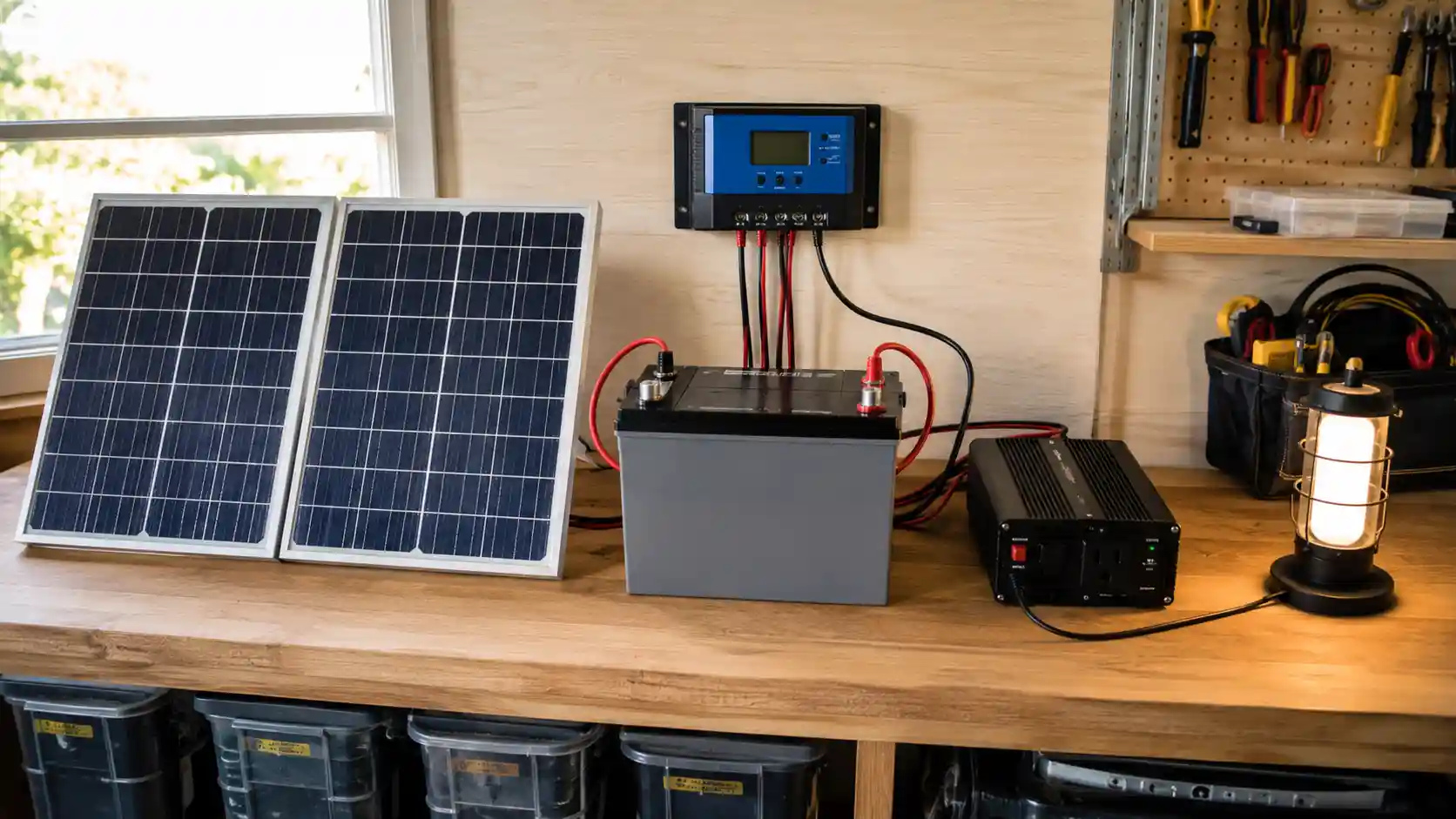
A small solar system can look simple from the outside: one panel, one controller, one battery. The real work starts when those parts must operate together. For panel-side planning, this solar panel performance and selection guide helps explain why output is never only about the wattage label.
Charge controllers are often treated as a small accessory in a solar kit, but they sit at the center of many off-grid and battery-based systems. They manage how solar energy moves into the battery, protect against unsafe charging conditions and help the system behave predictably over time.
A solar charge controller is not just a connector between the panel and the battery. It is the part that decides how safely and efficiently charging happens.
Start With the System Type
Before choosing a charge controller, define the kind of solar system being built. A camping power box, a garden lighting setup, a shed battery system, a small cabin installation and a hybrid home backup system all have different requirements.
Small DC systems
These systems may power LED lights, USB charging, small fans, routers, cameras or low-voltage equipment. They are usually simpler and may not require an inverter if all loads are DC.
Battery backup systems
Battery backup systems need more careful planning because the battery must store enough energy for the expected runtime. The controller must match the battery chemistry, voltage and charge current requirements.
Expandable solar kits
If the system may grow later, the charge controller should not be selected only for the first panel. It should leave room for additional solar capacity, higher charging current or a larger battery bank if expansion is part of the plan.
Understand the Job of a Charge Controller
A solar panel can produce voltage whenever light reaches it. A battery, however, needs controlled charging. The charge controller manages that process so the battery is not overcharged, over-discharged or charged with the wrong profile.
What the controller helps manage
- Charging voltage and current
- Battery protection
- Solar input limits
- Load output, where supported
- Battery type settings
- System monitoring through display or communication features
- Safe charging behavior during changing sunlight conditions
The controller cannot fix a poorly matched system, but it can help a well-designed system run more safely and consistently.
PWM vs MPPT: Choose Based on the System, Not the Buzzword
Most small solar buyers compare two common controller types: PWM and MPPT. Both can be useful, but they are not interchangeable in every situation.
PWM charge controllers
PWM controllers are usually simpler and more affordable. They can work well in small 12V or 24V systems when the solar panel voltage is closely matched to the battery voltage.
For a basic garden system, shed light, small backup battery or low-cost learning project, PWM may be enough if the panel, battery and load are correctly matched.
MPPT charge controllers
MPPT controllers are more advanced. They can convert higher panel voltage into battery charging current more efficiently and often perform better when the solar array voltage is higher than the battery bank voltage.
MPPT is often a better choice for larger panels, expandable systems, colder climates, longer wire runs or projects where every watt of available solar production matters.
A practical rule
Use PWM for simple, low-cost, closely matched systems. Consider MPPT when the system is larger, expandable, voltage-flexible or expected to deliver stronger performance from limited sunlight.
Match the Battery First
Many buyers start by choosing a solar panel, but in a battery-based system, the battery often sets the rules. The controller must support the battery voltage and chemistry.
Common battery types
- Flooded lead-acid: familiar and widely available, but needs correct charging and maintenance.
- AGM: sealed and lower maintenance, but still sensitive to improper charging.
- Gel: requires careful voltage settings and should not be charged aggressively.
- LiFePO4: popular for solar storage because of usable capacity and cycle life, but requires compatible charging settings and a proper BMS.
The controller should have the correct charging profile for the battery. If it does not, the system may undercharge, overcharge or shorten battery life.
Do not guess battery settings
Battery labels and datasheets should be checked before setting charge voltage, float voltage, low-voltage disconnect and battery type. Guesswork can damage batteries quickly.
Check Voltage Compatibility
Voltage matching is one of the most important parts of solar controller selection. A controller may support 12V, 24V or both automatically, but that does not mean every panel and battery combination is acceptable.
Battery bank voltage
The controller must support the battery bank voltage. Small systems often use 12V. Larger systems may use 24V or 48V to reduce current and improve efficiency.
Solar panel input voltage
The solar array must stay within the controller’s maximum PV input voltage, including cold-weather voltage rise. This is especially important when panels are wired in series.
Load voltage
If the controller includes load terminals, those loads must match the system voltage and current limits. Heavy loads should not be connected to small controller load outputs unless the controller is designed for them.
Most small solar failures are not caused by sunlight. They are caused by parts that were never properly matched.
Current Rating: Leave a Safety Margin
Charge controllers are usually rated by current. A 20A or 30A controller may sound straightforward, but the selected rating should include a safety margin for real-world conditions and future expansion.
Basic sizing idea
For a rough estimate, divide solar panel wattage by battery voltage to estimate charging current. For example, a 300W array charging a 12V battery may produce around 25A before losses and controller behavior are considered. In that case, a controller rated too close to the limit may not be a comfortable choice.
Expansion changes the calculation
If a buyer plans to add more panels later, the controller should be sized for the future array, not only the first module. Otherwise, the upgrade may require replacing the controller sooner than expected.
Panel Wiring: Series or Parallel?
How panels are wired affects voltage, current, cable size and controller compatibility. This choice should be made before buying the controller or adding more modules.
Parallel wiring
Parallel wiring keeps voltage similar while increasing current. It is common in small 12V systems but may require thicker cables and proper fusing when current increases.
Series wiring
Series wiring increases voltage while current stays similar. This can reduce cable losses and work well with MPPT controllers, but the array voltage must remain below the controller’s input limit.
Series-parallel wiring
Larger arrays may use series-parallel wiring to balance voltage and current. This requires more careful planning, especially when panels are not identical.
Do Not Ignore Wire Size and Protection
A correct controller cannot protect a system from every wiring mistake. Cable size, fuses, breakers and disconnects are core safety parts, not optional extras.
Safety items to include
- Correct wire gauge for current and distance
- Fuse or breaker between battery and controller
- PV disconnect or protection where appropriate
- Proper polarity checks before connection
- Weather-resistant connectors for outdoor wiring
- Strain relief and secure cable routing
- Clear labeling for future maintenance
Battery protection comes first
The battery can deliver high current very quickly. A fuse near the battery positive terminal is one of the simplest ways to reduce risk if a fault occurs.
Monitoring Makes Troubleshooting Easier
A display, app or monitoring function can help users understand how the system behaves. For small systems, even simple information like battery voltage, charging current and load status can be useful.
Useful controller data
- PV input voltage
- Charging current
- Battery voltage
- Battery state or charging stage
- Load output status
- Error codes or protection warnings
- Daily or total energy production, where supported
Monitoring helps turn a solar system from a black box into something the owner can actually understand.
Common Matching Mistakes
Most controller problems can be traced to system design decisions made before installation. The good news is that many of these mistakes are easy to avoid with a careful checklist.
- Using a controller that does not support the battery chemistry
- Exceeding the PV input voltage limit
- Choosing a controller with too little current capacity
- Connecting heavy loads to small load terminals
- Mixing unmatched solar panels in one array
- Using wire that is too thin for the current
- Skipping fuses or breakers
- Assuming a 12V panel always matches a 12V battery system
- Expanding the system without checking controller limits
A Better Buying Checklist
Before buying a solar charge controller, panels or batteries, system owners should write down the main specifications. This makes product comparison easier and helps avoid mismatched parts.
Checklist before purchase
- Battery voltage: 12V, 24V or 48V
- Battery chemistry: lead-acid, AGM, gel, LiFePO4 or another type
- Total solar panel wattage
- Panel open-circuit voltage and operating voltage
- Planned wiring: series, parallel or series-parallel
- Controller type: PWM or MPPT
- Controller current rating
- Maximum PV input voltage
- Expected load size and runtime
- Need for display, USB output or communication features
- Future expansion plans
A good small PV system is not built from random compatible-looking parts. It is built from numbers that agree with each other.
Final Thoughts
Solar charge controllers may look like small components, but they play a major role in battery-based PV systems. They help protect the battery, manage charging and keep the system working within safe electrical limits.
The best results come from matching the controller to the battery first, then checking panel voltage, array current, wiring design, safety protection and future expansion. When the parts are selected as one system rather than separate purchases, small solar becomes more reliable, easier to maintain and safer to use.